Changing the way the world thinks about what human beings are capable of.
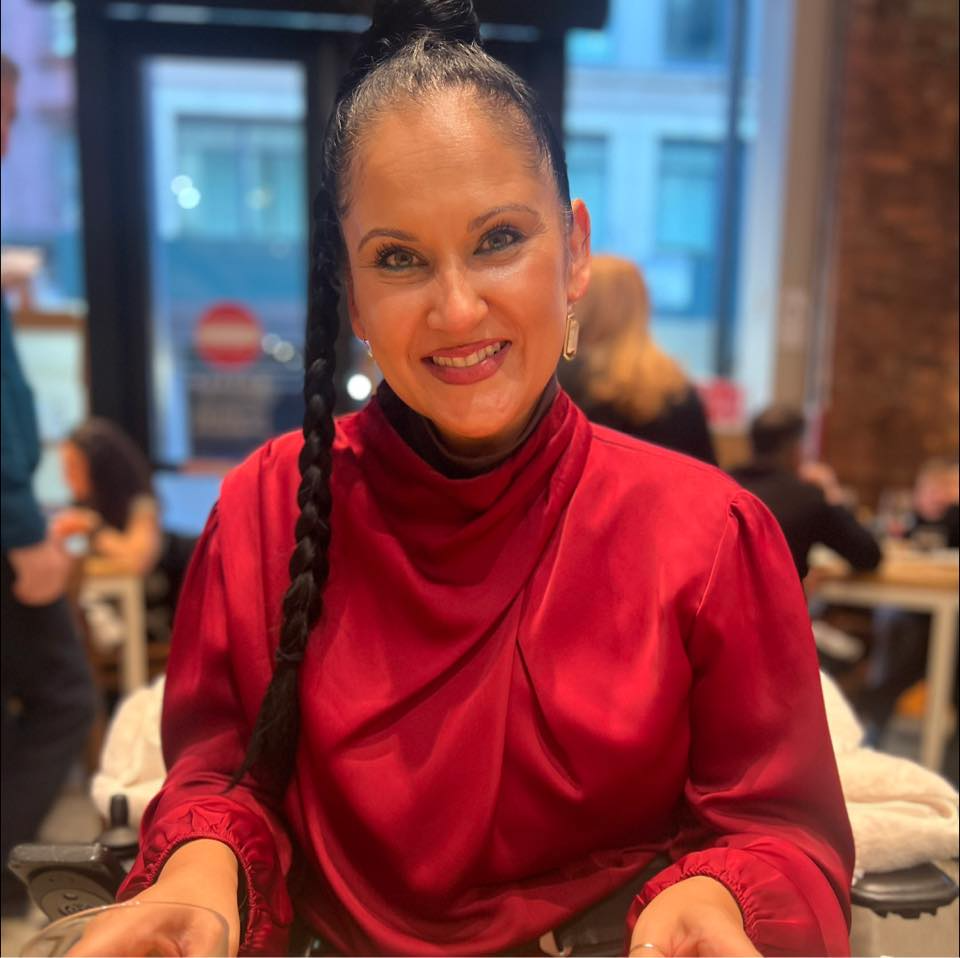
Cara Yar Khan
GLOBAL DISABILITY ADVOCATE
FORMER FOREIGN POLICY ADVISOR
UNITED NATIONS HUMANITARIAN
SPEAKING FEE: $10,000 - $20,000
EXCLUSIVE
Meet Cara
Subject of the Hillary Clinton and Chelsea Clinton’s executive produced documentary “Facing the Falls”, chronicling her expedition through the Grand Canyon
Served as Senior Advisor on International Disability Rights at the U.S. Department of State
Recognized global voice advancing disability rights, accessibility, and inclusive development
Cara Yar Khan is a global disability advocate and former White House appointee who served at the U.S. Department of State as a senior advisor advancing international disability rights in U.S. foreign policy. She founded The Purple Practice, a New York City–based boutique consultancy brokering disability-inclusive partnerships and investments.
Cara was selected by the Governments of Germany and Jordan, with the International Disability Alliance, to host and moderate the 2025 Global Disability Summit in Berlin. She has also spoken at the 2024 Global Citizen Festival in New York, the G7 Ministerial on Inclusion and Disability in Italy, the 2024 Paris Paralympics and 2026 Milano Winter Games, and annually at the UN Conference of States Parties to the CRPD. Most recently the Valuable 500 selected Cara to host SYNC25 in Tokyo.
Her international career began with the UN World Food Programme in Ecuador and corporate communications at Dell Technologies in Panama, before leading corporate partnership development for UNICEF with postings across Africa, Asia, and the Caribbean, including two years in Haiti after the 2010 earthquake.
Cara is featured in the documentary short Facing the Falls, executive produced by Hillary Clinton and Chelsea Clinton. Her TED talk, “The Beautiful Balance Between Courage and Fear,” has nearly 3 million views and is translated into 27 languages. She holds a master’s in International Public Policy from Johns Hopkins SAIS and speaks fluent Spanish, with working Portuguese, French and Italian and basic Mandarin.
SPEAKING TOPICS
-
Based on her popular TED Talk, Cara Yar Khan lays out a counterintuitive leadership operating system: courage isn’t the absence of fear, it’s the decision to keep moving with fear in the room. After being diagnosed with a rare progressive muscle-wasting disease, Cara was told to scale down her dreams. Instead, she built a life where ambition stays intact while the body changes.
This keynote gives leaders a practical framework for high-stakes choices: how to act without certainty, how to stop “confidence theater,” and how to build teams that can carry fear without collapsing into avoidance or bravado. Expect a talk that’s visceral, funny in parts, and deeply usable because the goal isn’t inspiration, it’s execution.
-
Facing the Falls follows Cara Yar Khan’s 12-day Grand Canyon expedition as an act of advocacy and it becomes something more uncomfortable: a confrontation with fear, trust, vulnerability, and the seduction of “capability” as identity. The film isn’t a neat hero story. It’s messy, adrenaline-filled, and honest about what happens when your body becomes a public referendum on your worth.
For organizations, this is a talk about psychological safety in the wild: how teams respond to unplanned risk, how leaders earn trust when control is impossible, and how the drive to “perform strength” quietly breaks people. It’s also a sharp critique of ableism including the kind we carry inside ourselves. Pair the talk with a viewing party of the film to set the tone for an immersive experience.
-
Most hiring committees claim they select on performance, then default to “signal”: presence, stamina, risk tolerance. Disabled bodies get misread as executive fragility, and that shortcut narrows the leadership pipeline with stunning confidence. This talk names the bias plainly and replaces it with a decision discipline: What evidence would we demand if this candidate’s body looked different?
Disability advocate Cara Yar Khan translate this into a practical playbook for boards, search firms, and CHROs: how to interrogate “executive presence,” how to separate aesthetics from capacity, and how to measure judgment and execution instead of comfort and familiarity. If you want disability inclusion without the performative fluff, this is the keynote.
-
Most organizations try to “do disability inclusion” by launching policies. This talk argues the opposite: disability inclusion starts with what you say, what you show, and what you assume because communications shape culture, and culture determines belonging. Accessibility is the baseline (can people perceive, understand, and engage with what you share?). Inclusion is the deeper layer (does your language, framing, and imagery communicate respect, agency, and equal expectation?). You need both or you end up technically compliant while still quietly othering people.
Through carefully crafted stories and scenarios, global disability advocate Cara Yar Khan gives audience the rare gift of recognizing their own internalized ableism without being shamed and then they get tools to shift it. We break down how tone and underlying disability “models” drive stigma, how the wrong narrative turns people into objects of pity or inspiration, and what to stop saying if you want belonging instead of performative allyship. The session ends with a practical toolkit: inclusive language choices, representation cues, and the accessibility fundamentals (alt text, captions, CART/real-time access, and universal-design habits) so inclusion isn’t a retrofit, it’s how you operate. In other words, it’s not something you do, it’s the way you do things.
-
Based on her powerful TIME essay, global disability advocate Cara Yar Khan draw a line leaders rarely articulate: As someone struggling every day, but not suffering, that distinction changes everything about how we design support. Disabled professionals are too often evaluated on “independence” rather than outcomes, as if needing help is disqualifying instead of strategic.
This talk reframes accommodations as performance infrastructure no different than executive assistants, security protocols, or travel choices that protect readiness. The punchline is blunt: access is not charity. It’s an investment decision, and high-performing organizations budget for performance.