
Imagination is not a luxury. It’s a strategy
What Does Imagination Actually Have to Do With Your Organization?
More than you'd think. Probably more than you've ever been told.
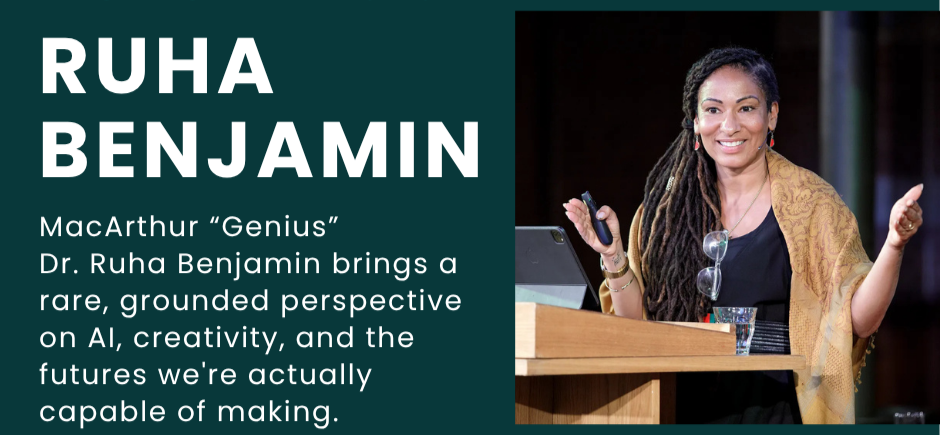
Dr. Ruha Benjamin isn't just a compelling speaker. She's a scholar who has spent her career asking the one question that most organizations quietly avoid: What kind of future are we actually imagining, and for whom?
She's a Princeton professor, founding director of the Ida B. Wells Just Data Lab, author of Race After Technology, Viral Justice, and most recently Imagination: A Manifesto. She was named a 2024 MacArthur "Genius", which is the kind of recognition that tends to mean someone has been doing serious work that the rest of the world is only starting to catch up to.
And right now, her work sits at the center of a conversation that is happening in boardrooms, strategy sessions, and HR departments everywhere: what does it mean to actually innovate, lead with vision, and build something that lasts?
The Word "Innovation" Has a Problem
Here's something Ruha says to tech audiences that tends to land hard: if a new development continues to exacerbate social problems, we shouldn't even call it innovative. That's not a political statement. It's a definitional one. And it has real business implications.
BCG has made a version of this same argument from the strategy side: organizations that fail to systematically harness imagination struggle to grow, recover from disruption, or compete over the long term. In their research on what they call "imagination capacity," fewer than one-third of respondents felt confident their companies could harness imagination at all. Most leaders agree it matters. Very few have built it into how they actually operate.
Ruha's contribution to this conversation is distinctive because she doesn't just talk about imagination as a creative tool. She talks about it as a contested resource. She argues that dominant imaginaries, the stories powerful actors tell about what's possible, what's profitable, what counts as progress, shape our institutions just as much as any policy or org chart. And the more powerful those stories are, the less visible they become.
For leaders, that's worth sitting with. The assumptions baked into your AI strategy, your hiring practices, your product roadmap? They came from somewhere. They reflect an imagination. The question is whose, and whether it's actually serving you.
From Zero-Sum to Something More Durable
One of the more striking things Ruha talks about is the shift from a zero-sum frame, the idea that for one group or team or company to win, someone else has to lose, to what she calls a solidaristic understanding of how we relate to each other.
She's not asking organizations to be charitable. She's citing data. Research consistently shows that in contexts with wider inequality, even the so-called "winners" don't fare as well as their counterparts in more equitable environments. Anxiety, disengagement, loss of trust, higher turnover: these are outcomes that affect the top of the organization too, not just the bottom.
For associations, this speaks directly to the work of belonging and member engagement. For corporations, it maps onto culture, retention, and the real costs of a workforce that doesn't feel seen or invested in. In both cases, the argument isn't moral first. It's practical first, and moral too.
Imagination as Leadership Practice
There's a thread running through work on creative leadership that connects to Ruha's ideas in a direct way. Effective leaders, the research suggests, need imagination not just for innovation but for risk management, for navigating uncertainty, for seeing what their organizations might be missing. An active imagination allows leaders to envision a future state and articulate it in a way that actually moves people.
What Ruha adds is the harder question: are we drawing on the full range of knowledge and experience available to us when we imagine? Or are we defaulting to the usual sources, the usual credentials, the usual rooms?
She tells a story about a healthcare AI team that made their predictive tool more accurate and less biased by training it on patients' own reports of pain rather than doctors' notes, which were known to reflect systemic racial bias. They didn't just optimize the existing system. They questioned where knowledge was coming from in the first place. That shift led to something genuinely better by every measure.
That's what expanded imagination looks like in practice. And it's a model that applies well beyond healthcare.
Why This Speaker, Why Now
In a moment when every organization is being asked to make sense of AI, to demonstrate commitment to equity without reducing it to a checkbox, to lead through volatility and stay focused on long-term value, Ruha Benjamin offers something genuinely rare: a framework that holds all of those things together without pretending they don't create tension.
She's not here to reassure anyone. She's here to sharpen the questions. And in our experience, those are the speakers that audiences remember.
Her keynote and program topics range from "Imagination: Beyond Buzzwords" to "Race After Technology" to "Ustopia," her framing for how we move past both naive optimism and paralyzing doom when it comes to tech and its future.