
You Use the Gig Economy Every Day. But You've Probably Never Heard of the Woman Who Built It.
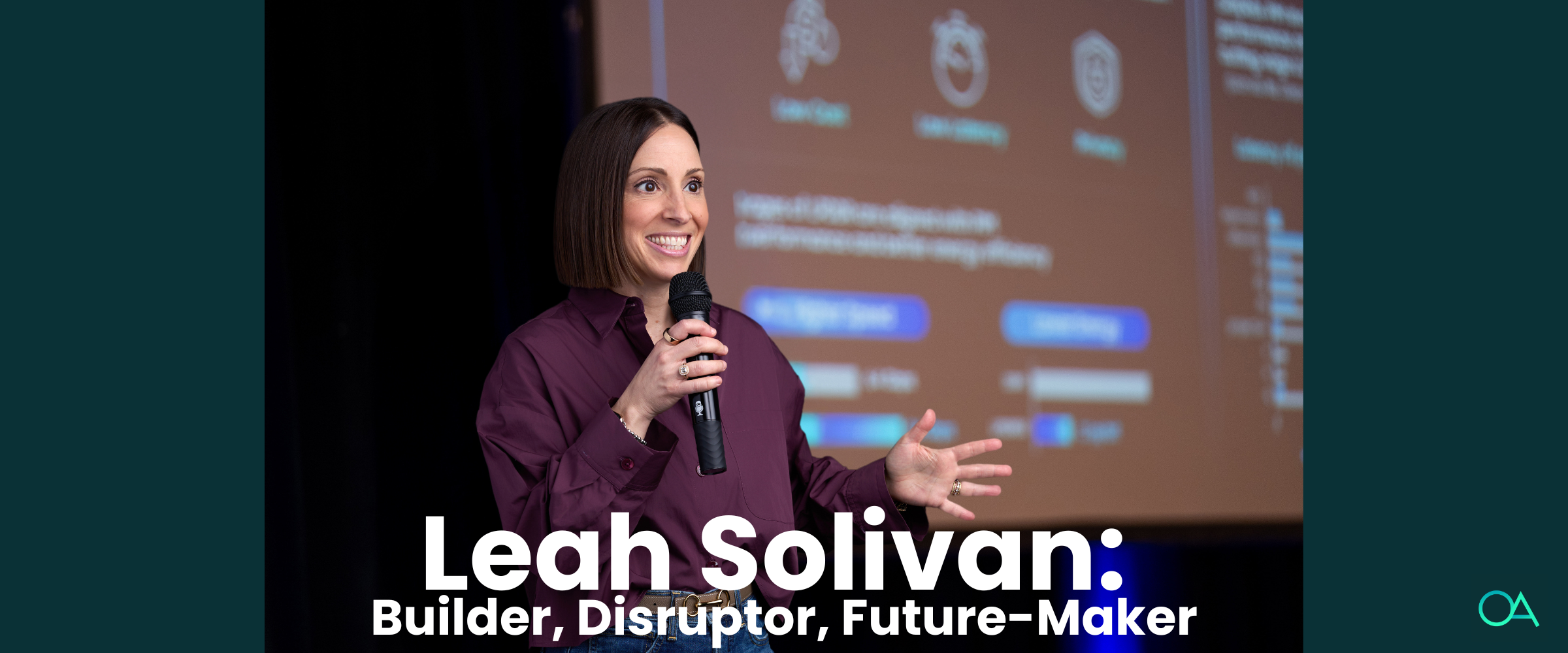
Leah Solivan founded TaskRabbit, sold it to IKEA, and now invests in AI from Fuel Capital. Here's why she's the keynote speaker your next event needs — and why almost nobody knows her name yet.
The Origin Story the Gig Economy Forgot
Ask most people to name the founders of the gig economy and you'll hear the same names: Travis Kalanick (Uber), Brian Chesky (Airbnb), Tony Xu (DoorDash). They are, by any measure, household names. Their companies reshaped how the world moves, travels, and eats. Their origin stories have been turned into books, documentaries, and business school case studies.
But here's the thing: there was a platform that came before many of them. One that proved, at a time when nobody believed it, that the internet could be trusted to connect strangers for labor. That people would actually pay for help with their to-do lists through an app. That a two-sided marketplace for human tasks could scale, raise venture capital, and operate internationally.
That platform was TaskRabbit. And the person who built it was Leah Solivan.
In 2008, the same year Airbnb was launching out of a San Francisco apartment, Leah was a software engineer at IBM. She had a stable job, a good salary, and a pension. One night, she realized she ran out of dog food. The idea struck her: what if you could hire anyone nearby to do any task, right from your phone?
She withdrew $20,000 from her IBM pension, quit her job, and started building RunMyErrand.com in Boston. It would later become TaskRabbit—the pioneering on-demand marketplace that scaled to 44 cities, raised more than $50 million in venture funding, and in 2017, was acquired by IKEA in one of the defining exits of the platform economy.
“Without TaskRabbit proving the on-demand labor model worked, the entire category would have faced a much harder path to venture funding. Leah Solivan built the proof of concept for an economy that now employs tens of millions of people.”
Why Your Audience Uses Her Work Every Day (Without Knowing It)
Every time someone orders groceries through Instacart, gets dinner delivered via DoorDash, or books a handyman through an app, they're living inside an economic model that TaskRabbit helped prove was possible. The on-demand service marketplace—the concept that people will pay a platform to connect them with vetted, available workers in real time—was a genuinely radical idea in 2008.
Investors said it wouldn't work. They said people would never trust strangers in their homes. They said the liability was unmanageable. They said the unit economics would never pencil. Leah built it anyway, and proved all of them wrong, which is precisely what made the entire category investable for every company that followed.
She's the person who taught the market to believe in this model. The person who should be mentioned first when we drum on about the other founders who scaled platforms on top of the proof she created.
What She's Done Since

Since the IKEA acquisition, Leah hasn't slowed down. She's accelerated. Today, she is a Managing Director at Fuel Capital, where she manages three funds and a portfolio of more than 116 companies spanning AI, Fintech, consumer, digital health, and marketplace businesses. Her portfolio includes names like Nanit, Ourplace, and Pacaso.
In 2024, she was nominated to the Board of Directors of The Walt Disney Company. She currently sits on the board of PetMed Express (NASDAQ: PETS), chairs the YPO Regional Board, and holds a seat on the YPO International Board, giving her a network of senior business leaders across 142 countries.
She speaks regularly at the World Economic Forum in Davos. She is the host of Breaking Precedent, a podcast on what it means to rewrite the rules. And Fast Company named her one of its "100 Most Creative People in Business."
She is, in short, one of the most accomplished and underrecognized figures in the business world. Which is either a shame or an opportunity, depending on whether you book her first.
Leah Solivan is accepting 2026 bookings.
Select dates are still available for Q3 and Q4. Her calendar fills quickly. If your event is this year, now is the time to inquire.
Three Talks. Three Audiences. One Rare Voice.
What makes Leah an unusually versatile keynote speaker is that her story is genuinely relevant across multiple audience types, and not because she tailors it artificially, but because the things she has actually done touch on the questions that matter most to corporate leaders, HR professionals, innovation teams, DEI advocates, and anyone navigating the AI shift.
Talk 1: The Marketplace Playbook
The full arc from founding idea to IKEA exit to active VC investing told as a practitioner's guide, not exclusively as a founder’s story. This talk covers the counterintuitive decisions behind platform economics: why she chose IKEA over a higher bidder, how trust becomes your most important infrastructure, and what she's betting on now as an investor watching the next generation of marketplace companies.
Best for technology conferences, retail and e-commerce events, Fintech, and corporate innovation audiences.
Talk 2: Breaking In
One of the few Latina founders to raise institutional venture capital and achieve a major platform exit, Leah brings a tactical framework for building without a playbook when the system wasn't built for you. This is not a talk about perseverance. It is a talk about the specific, often uncomfortable decisions that separate people who wait from people who build.
Best for DEI-focused events, women's leadership summits, ALPFA, LATINA Style, YPO, and STEM pipeline audiences.
Talk 3: AI in the Wild
This is Leah's freshest and most urgent talk, and the one that most directly addresses what every organization is grappling with right now. Rather than offering predictions or hype, she draws on her vantage point as an active investor watching AI reshape consumer behavior, hiring patterns, trust dynamics, and product decisions across 116 companies. She shows audiences what AI is already doing (not what it might do) and gives leaders a clear-eyed framework for decision-making without requiring a technical background.
Best for HR Tech, future of work conferences, financial services, corporate innovation, and association annual meetings.
Why She's the Speaker This Moment Needs
The keynote speaking market is full of people who have studied disruption, written books about it, or consulted on it. Leah Solivan actually did it. She built a company in the middle of the 2008 financial crisis that nobody believed in, scaled it across two continents, sold it to a Fortune 500 company, and is now identifying the next wave from the inside of an expertly curated portfolio.
That is a credential set that is extremely rare. And the story she tells is one that every audience, from students ready to learn how AI might change their career futures to C-suite executives, can immediately recognize because they are living inside the world she helped build.
When your attendee opens their DoorDash app tonight, they will be using the model she proved worked. When they hire a handyman through TaskRabbit, they will be using the platform she built. And when they wonder what AI is going to do to their industry, they will be asking the exact question she has been answering in her portfolio for the past five years.
There aren't many speakers who can say that. Leah Solivan is one of them. And she’s ready to help you think differently about your next move.